Cnet compares the Nikon D80 vs. Canon Rebel XTi and writes 'What an upset! The Nikon D80 might be a bit more expensive than the XTi, but it's clearly worth that extra couple of hundred bucks. Though they're evenly matched for photo quality, the Nikon delivers enough extra oomph across the board to claim victory. But the Rebel ain't the Rebel for nothing--we're sure it'll be back for a rematch next year!'
Read the full comparison of Nikon D80 vs. Canon Rebel XTi
Showing posts with label digital camera. Show all posts
Showing posts with label digital camera. Show all posts
Monday, November 06, 2006


Panasonic Lumix DMC-LX2
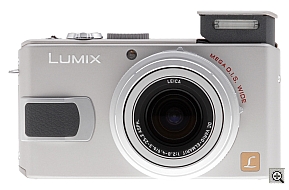
Resource reviews the Panasonic Lumix DMC-LX2 and writes - 'With all the new digital SLR cameras on the market, there are some reviewers out there who have dubbed 2006, "the year of the DSLR." Because of the ongoing collaboration between Panasonic and Leica, however, I might be more inclined to call it, "the year of the rangefinder." The Panasonic LX2 carries on the same classic Leica styling as the previous model, looking virtually identical to the LX1. Like the LX1, it comes in silver or black and while the test unit I tried out was silver, for my tastes, the black stays much truer to the classic rangefinder style.
Aside from the superficial styling of the camera, the Panasonic DMC-LX2 is certainly no rangefinder. Since the huge LCD takes up most of the rear of the camera, there's no room for an optical viewfinder, a scenario that is becoming almost standard on digital cameras these days. Despite its slightly boxy profile, the LX2 is a compact digital camera with enough contours and a not-too-obtrusive snub-like lens (28mm-112mm in 35mm equivalent) to fit comfortably in a bag or coat pocket. Dimensions of the camera are 4.2 x 2.2 x 1.0 inches (106 x 56 x 26 mm) and weight is just 7.6 ounces (217g), so while it has as many features as some prosumer models, it's far more portable.
Though the appeal of the Lumix DMC-LX2's design might be generational -- it certainly looks like what a camera should look like to anyone who can still remember the glory days of film -- it also has enough flash to appeal to younger photographers. Whether the network of manual options on the LX2 will interest anyone beyond the advanced amateur set remains to be seen. I hope it does, because once you start exploring the LX2's broad functionality is when fun begins.'
Basic Features
- 10-megapixel (effective) 16:9 CCD captures images as high as 4,224 x 2,376 pixels
- 2.8-inch color TFT widescreen (16:9) LCD with 210,000 pixels of resolution
- 4x zoom lens (equivalent to a 28-112mm lens on a 35mm camera)
- Maximum 4x digital zoom, plus "Extended Optical Zoom" to 6.2x depending on aspect ratio
- Automatic, Program, Aperture Priority, Shutter Priority, and Manual main exposure modes
- Shutter speeds from 1/2,000 to 60 seconds, with available Noise Reduction for longer exposures
- Maximum aperture from f/2.8 to f/4.9, depending on lens zoom position
- Built-in flash with six modes and an intensity adjustment
- SD/MMC memory card slot for storage (16MB of built-in memory)
- Power supplied by one proprietary, rechargeable lithium-ion battery
- Panasonic Lumix software package includes Lumix viewers, Arcsoft suite, and SILKYPIX Developer Studio 2.0 SE
Pentax Optio A10

Resource reviews the Pentax Optio A10 and writes - 'On the surface, the Pentax Optio A10 would seem to be the ideal travel camera. With a small, solid, form factor, the A10 is perfect for stuffing into a travel bag or coat pocket and hitting the road. It also boasts a large 2.5-inch LCD with 232,000 pixels of resolution for excellent image playback that's great for sharing shots with friends. On paper at least, the camera would also seem to have enough firepower -- including an eight-megapixel image sensor and a Shake Reduction System for reducing image blur -- to produce decent images. Unfortunately, however, those specs did not translate to great image quality in my testing. Many shots I took were surprisingly soft with much image noise when set to anything above ISO 200. Chromatic aberration, including purple fringing turned up quite a bit in shots taken in high contrast situations such as trees against a sky. While the Shake Reduction System worked well for still or slow moving images in average shooting conditions, it failed to reduce blur in even moderately low-light settings when zooming. In general, moving objects were difficult to keep in focus even when using the Pentax A10's Sport Mode, which uses an unusual and largely ineffective tracking autofocus function.'
Read more reviews of the Pentax Optio A10
Sony Cyber-shot DSC-T30 Digital Camera

Digital Camera Info reviews the Sony Cyber-shot DSC-T30 Digital Camera where they write - 'The 7.2-megapixel Sony Cyber-shot DSC-T30 offers consumers a lot of style, some imaging capabilities, and little overall value. The camera is nicely packaged in a metal body that is skinny enough to slide into a pocket, but also has a few features that make it easier to handle than most ultra-compact digital cameras. The Sony T30 has some positive points to its components too: the image stabilization is effective in keeping shakes out of the 3x optical zoom, the 3-inch LCD screen is large and has good resolution, and the ISO extends to a sensitive 1000 rating for low light shots. There are drawbacks too: the burst mode is slow, the LCD is fragile, and the movie mode requires a separate Memory Stick Pro Duo card to function at full speed. The pictures from the Sony T30 look good and the movies garnered from the Pro card look good, but the quality still doesn’t justify the enormous price tag. At $499, the Sony Cyber-shot DSC-T30 is the most expensive ultra-slim digital camera on the market.'
Fujifilm FinePix S6000fd

Digital Camera Info reviews the Fujifilm FinePix S6000fd where they write - 'The 6.3-megapixel Fujifilm FinePix S6000fd touts its face detection technology foremost, but has a lot of other features to brag about. The 10.7x optical zoom lens has the look and feel of an interchangeable model, but remains sealed and keeps dust out of the camera. There is plenty of manual control, albeit sometimes difficult to access. The i-Flash system keeps details in the background of pictures and doesn’t over-exposure faces. The combination of the i-Flash system and the face detection technology keeps portraits perfectly focused and exposed. The Fujifilm FinePix S6000fd is one of the best digital cameras out there for portrait photography, but it doesn’t do well in other areas. It lacks image stabilization and its zoom ring is difficult to smoothly control, so movies are jumpy. The zoom and focus rings are great to work with when shooting still images, but don’t function well at all while shooting video. The S6000fd is definitely not a candidate to be one of those ultra-zoom hybrid digital cameras, so it won’t be a crowd pleaser with the mass market. The SLR-shaped camera, called the FinePix S6500fd in Europe, retails for $499 and will be a good camera for consumers who want to take fabulous portraits or shoot indoors with available light.'
Subscribe to:
Posts (Atom)