Wednesday, December 06, 2006

Canon Rebel XT


Canon Rebel XT (Canon EOS 350D) is an 8.0 Megapixel (APS-C CMOS sensor) DSLR with a 3 frames per second shooting rate (14 frame bursts) that Canon believes will take over from where previous Rebel releases have left off. It has the same DIGIC II image processor of found in the high end professional 'D-series' of DSLRs.

Steves Digicams reviews the Canon EOS Digital Rebel XT / EOS 350D and writes - 'The Digital Rebel XT's 12 exposure modes are easily selected by a turn of the top-mounted Mode dial. These exposure modes cover virtually all the shooting conditions you'll ever encounter and are: Full Auto, Portrait, Landscape, Close-up, Sports, Night Portrait, Flash Off, Program AE, Shutter speed-priority AE, Aperture-priority AE, Manual and Auto Depth-of-Field AE. The camera's ISO sensitivty range is 100, 200, 400, 800 and 1600, Canon raised the Auto ISO setting to include ISO 400 in order to help improve image quality, reduce camera shake and brighten the scene behind the subject when taking a flash photo.'

Nikon D70s


Nikon today have announced the Nikon D70s DSLR - an upgrade of the previously released D70 model. The D70s features a larger 2 inch LCD monitor, newly re-designed menus, better auto focus, wider flash coverage and a longer lasting battery. It will reatail at $1200 with an 18-70mm lens or $900 as a body only package. Expect to see it in stores early May 2005.

Byte Sector has a review of the Nikon D70s DSLR and writes - 'Overall, I had a really great time working with the Nikon D70s. The camera is incredibly versatile and has more advanced features than most other DSLR cameras in its price range. Granted, the fact that it only has a 6MP CCD is a major limiting factor when you consider that the Canon Digital Rebel XT has an 8MP sensor, has similar if just slightly less advanced features, takes pictures almost as well, and is about $300 CAD cheaper. Even the Olympus E300 offers an 8MP CCD as well as two lenses for the same price as the Rebel XT.'

Think Camera has posted their review of the Nikon D70s where they write - 'This camera meets the needs of many. The digital vari-programs will suit those who still prefer a method of photography closer to point and shoot; on top of which, if you don't want to get your hands dirty with exposure, there's always Program mode. This sparks up bracketing and other ways to optimise image quality. Professionals and anoraks will revel in the plethora of options (only some of which I have covered). However, both beginners and advanced users will benefit from this camera's main strengths - build quality, great design and great image processing.'

Nikon D40 Review at Ken Rockwell


Ken Rockwell posts his review of the Nikon D40 where he recommends - "I'm suggesting the D40 to my friends who just want great pictures of family, kids and friends. The D40 is for normal people who just want great pictures, not photographers who want fancy cameras. The D40 is the smallest and lightest Nikon DSLR ever. Photographers may use this for a backup, but the lack of immediate access to the critical adjustments photographers make for each shot could drive active photographers up a wall. "

Read more reviews of the Nikon D40

HP R967 Review at Megapixel


Megapixel reviews the HP R967 and writes - 'The image quality the 10-megapixel CCD yields varies greatly with the compression used. The R967 provides 4-JPEG compression levels, each identified by a number of stars. The highest image quality is obtained with the compression, but it is only accessible as a custom option of the image quality settings. At this level, images reveal no compression artefacts, and retain a good overall sharpness. However, as soon as the compression is increased, a commensurate loss of details can be observed.'

Read more about the HP R967

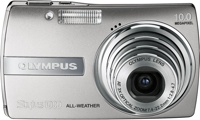
Olympus Mju Stylus 740 Review at DigiCam Review

Digicam Review has reviewed the Olympus Mju Stylus 740 where they give it a rating of 'above average' and write - "The Olympus Stylus / Mju 740 has a lot going for it, particularly the 5x optical zoom lens and ultra compact weather proof body. The camera would be especially suited to someone who wants to take their camera with them in all weathers. The solid build of this camera is likely to make it last well, and makes it good value for money. Image quality was generally good, although slightly under-saturated for some people's tastes, and images can be slightly soft. Noise was quite well controlled although worse indoors. The camera is very easy to use and there are a lot of features built in to help get better results, such as the digital image stabilisation and numerous scene modes."

Read more about the Olympus Mju Stylus 740

Monday, December 04, 2006

Red Eye Reduction with Photoshop CS2

Planetphotoshop.com has posted a tutorial on Red eye Reduction 'There are almost as many ways to minimize red eye using Photoshop as there are people using Photoshop. Ask a group of photographers which is the best way to minimize red eye and sparks are sure to fly!

Red eye is the condition that occurs when a camera's flash reflects off the back of a person's eye. Most common in portraits and group photos, it's generally a problem when the subject is looking directly at the camera. While most cameras have a "red eye reduction" feature (which uses a pre-flash to shrink the subjects irises before taking the photo), it's not always practical to use that feature.

In this figure, you see a comparison of five red eye reduction techniques. From the top¬ compare: the original, the Red Eye tool (Photoshop CS2 only), the Color Replacement tool, the Brush tool (using black, the Multiply blending mode, and 6¬0% opacity), the Sponge tool, and the Selective Color command.'

Read Full tutorial Here

Thursday, November 30, 2006

Point and Shoot Digital Camera Gift Ideas

Over at Digital Photography School today They have posted 45 Digital Camera and Photography Gift Ideas for those looking for inspiration for their Christmas lists.

The lists are based upon what readers of the site have been buying recently on Amazon. Here is the point and shoot digital camera category:

Point and Shoot Cameras

  1. Canon PowerShot SD630
  2. Canon PowerShot SD600
  3. Canon PowerShot SD800 IS
  4. Fujifilm FinePix F30
  5. Sony Cybershot DSC-h2
  6. Nikon Coolpix S7c
  7. Canon PowerShot A530
  8. Canon PowerShot A540
  9. Panasonic Lumix DMC-FZ4
  10. Sony Cybershot DSCR1

Shutter Speed Tutorial

Trusted Reviews has posted a tutorial on Shutter speed and writes - 'Any movement in the frame during the exposure will be captured in the picture, resulting in motion blur. Anti-shake systems can do nothing to correct this; the only solution is to use a shutter speed fast enough to effectively freeze the action, which is why some camera manufacturers, most notably Fujifilm, have concentrated on producing CCD sensors with better high ISO performance, since this allows you to use faster shutter speeds in low light conditions.

With a fast enough shutter speed you can freeze even very fast-moving objects, as this sequence of photos will show. They were taken using a Nikon D200 SLR through the plane window on a flight to France, at shutter speeds of 1/125th, 1/250th, 1/500th, 1/1000th and 1/2000th of a second.....'

Read more at Digital Camera Tutorial: Shutter speed

Canon EOS Digital Rebel XTi Review at Digital Camera Info


Digital Camera Info has posted their review of the Canon EOS Digital Rebel XTi where they write - 'Plenty of users will enjoy the Canon EOS Digital Rebel XTi. In automatic modes, it's easy to use, and snapshooters will be pleased with its quality. If they don't make enlargements, though, users won't see a difference between shots from the 10-megapixel XTi and ones from lower-resolution cameras. DSLRs should have complete manual controls, and the Rebel XTi scores well on that account. However, it should have been more convenient to control and the dials and buttons should have been better designed, better finished, and more extensive.'

Read more about Canon EOS Digital Rebel XTi

Nikon Coolpix L6 Digital Camera Review


Digital Camera Review has reviewed the Nikon Coolpix L6 and writes - 'Overall, I'm very impressed with the Nikon Coolpix L6 - the camera is clearly designed to appeal to a specific target audience and it does a very good job of meeting the needs of that demographic. The camera is very user friendly and it consistently delivers surprisingly good images. It's an excellent choice for busy folks and casual photographers who want a camera that's compact enough to drop in a pocket and take along everywhere they go, tough enough to stand up to the rigors of modern life, cheap enough to be a real bargain, and if all that's not enough, the L6 has the best battery life of any digicam in its class. I wouldn't buy an L6 for me - but I would seriously consider buying one for my wife (who is a lifetime member of the L6's target audience).'

Read more reviews of the Nikon Coolpix L6

Panasonic Lumix DMC-L1 Digital Camera Review


Digital Camera Review has reviewed the Panasonic Lumix DMC-L1 and writes - 'The Panasonic Lumix DMC-L1 is an impressive camera that, frankly, is going to have a hard time contending with the competition. Image quality is excellent and the camera operates well. The included “kit” lens is far and away the best kit lens that you can get, with a fast maximum aperture of f/2.8. As far as ergonomics and styling, my opinion is that people are going to be split over whether they’re good or bad. Personally, I enjoyed the styling since it gave a more “mechanical” feel to operating the camera. Pushing levers and turning rings was more fun than just pressing buttons to make a menu choice. Overall, I liked the camera, but the only purchase option is a relatively expensive kit. I’m also not sure that the camera has enough added value to compare against similarly (and cheaper) priced kits, like the Nikon D80 and Canon EOS 30D.'

Read more reviews of the Panasonic Lumix DMC-L1

Olympus Stylus 1000 Digital Camera Review


Digital Camera Review has posted their review of the Olympus Stylus 1000 where they write - 'Image quality on the Stylus 1000 was good, and in my opinion, slightly better than the Stylus 750. The images were sharper and didn’t have the corner softness that I noticed with the Stylus 750’s images. However, colors and exposure were generally good. I highly recommend that you examine the sample images from our review and other reviews to form your own opinion. The speed of the camera was pretty average. Personally, I don’t really worry too much about start-up time, but it was around 2 seconds. Shot to shot time without flash was about 2 seconds. If you turn on the flash, you’ll have to wait a couple more seconds between shots for the flash to charge. Shutter lag was quick enough to capture the moment, but only if you achieve a focus lock first. Without a partial press first, shutter lag is around 0.6 to 0.8 seconds or so.'

Read more about the Olympus Stylus 1000